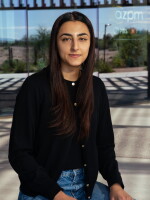
Casey Hassett knows what it’s like to be a deafblind student in a public general education setting.
“I experienced bullying, myself, in the mainstream environment,” she said through an ASL interpreter, addressing the Tucson Unified School District Governing Board.
Hassett worries that will be the same experience for students entering TUSD classrooms after the Tucson campus for the Arizona State Schools for the Deaf and Blind closes.
“Students deserve to learn in an environment where they feel safe, supported, understood and have full access to the resources they need to succeed,” she said. “Because of these concerns, I do not agree with the proposed plan under Agenda Item 9.1 regarding the transition of ASDB students into TUSD schools.”
With some hesitation, governing board members voted 4-1 in favor of an agreement between the two districts that would open a classroom in Morgan Maxwell K-through-8 and one in Pueblo High School for visually impaired ASDB students. Those two schools were deemed the most fit environments for the estimated 20 incoming ASDB students.
Jennifer Eckstrom was ultimately the only “no” vote at Tuesday night’s meeting.
“We don’t have all of the answers, we don’t know what teachers are going to be providing throughout the day, we haven’t talked to parents,” she said.
All other board members shared similar sentiments, saying TUSD services may not suffice the blind students who received a specialized education at ASDB. But TUSD Superintendent Gabriel Trujillo said he and a board member have sat down with ASDB parents and “made promises.”
One promise, Trujillo said, is to keep the 20 blind, visually impaired and deafblind students together and limit the relocation to just two TUSD campuses.
Families of blind students are left scrambling amidst a campus closure because ASDB is only set to relocate students in the deaf program to Oro Valley this summer. ASDB’s decision earlier this year to separate the blind students from their deaf peers was met with heated opposition from families, including a lawsuit.
According to the agreement with TUSD, ASDB does plan to provide assistive technology, Braille support and other teacher and specialist positions. TUSD must add its own speciality positions and upgrade facilities in time for next school year when the ASDB students are set to join the district. That will cost an initial $815,000 which the district plans to source from federal Medicaid funds.
Receiving waving arms from the audience — ASL for applause — Katie Sienko, president of the Arizona Association of the Deaf said TUSD’s ongoing budget limitations may make TUSD ill-equipped for upgrades in technology and support staff.
Others addressed the board with concerns over the agreement and in defense of ASDB families. “Isolation,” “lack of support” and “bullying” were common themes among speakers’ concerns.
Although he voted to approve the agreement, Val Romero said he doesn’t want this to be “an experiment” at the expense of student success.
“I would love to embrace our students in this community, I just want to make sure we do it right and we don’t fail them,” Romero said.
He plans to visit ASDB’s Tucson campus in the coming weeks to learn more about who is attending, what their needs are, and if TUSD can guarantee support.
Board member Sadie Shaw entertained the idea of keeping the current ASDB campus running somehow, with TUSD involved next year. However, since the campus is state property, TUSD would have to lease buildings and pay for maintenance which might not be feasible, board president Shah said.