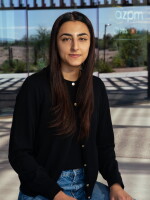
When poet and librarian Lindsey Curley (Diné) started the Golden Hour poetry showcase this year, she set out to offer a space of self expression for students like Rosemary Burton.
In a sun-lit room at the Richard Elías-Mission Library on Tucson’s west side, 10-year-old Rosemary cannot contain her smile. Turtle earrings dangling and her eyes peering toward her family, she reads “The Desert Life,” an ode to Tucson summers.
“Warm, bright sun / Kids in the pool / Having some fun / Cherry lollipops and catchy new bops.”
Rosemary is home-schooled, and it was her first time reading poetry aloud.
“I was nervous before, but when I got up there, I felt a little better,” she says while munching on a sprinkled donut after the show.
As president of the library’s Many Nations Affinity Team, Curley leads literacy-building opportunities for local Native communities.
“In a very spiritual sense, I want our holy people to be here on behalf of our lovely poets today watching over us,” she says, welcoming families to the showcase.
Curley is inspired to revitalize Indigenous traditions like oral storytelling and share them with all of Southern Arizona.
“We as a public institution no longer participate and carry on a legacy like that. And so, for us, continuing that thread of well-being within the library system, especially one that is open to everybody,” Curley says.
For rising sixth grader Tomi Marcus, this is just a typical day.
“I’ve won multiple other contests so this is normal,” he says.
He reads his poem “Class Clown,” which is based on true stories of his school days at Legacy Traditional.
“I feel a little bad for him / He just wants friends, wants to belong / So he lets them laugh even when it hurts / Each joke takes something small away from him.”
Next, in competitive Marcus spirit, Tomi’s older brother Tobi reads “Eyes on the Prize,” a poem he has memorized.

“Heart racing with every beat / But on the judge’s desk / Golden trophies, shiny prizes / Dreams that sparkled a little too loud.”
Curley says librarians are “often the ones that are great observers of our communities and what is needed,” and what’s needed is face-to-face connection, she says.
Curley, like many Pima County teachers, is noticing the effects of increased screen time.
“Especially coming out of the pandemic, we’ve observed a great deal of social disparities in terms of being able to communicate with each other.”
Spaces like Golden Hour, Curley says, can be “a way to kind of course correct” and to promote literacy beyond just reading books.
“This is something that we as Indigenous people are also in the process of doing in terms of revitalization and reclamation. Because we are trying to do that for ourselves, we also want to include other people within that journey,” Curley says.
Details for the following showcases can be found on the Pima County Public Library website. Submissions are open for children ages 9-18 and poems can be read in any language. Curley will pick around 15 finalists to read their poems at the Fox Theatre on June 28.