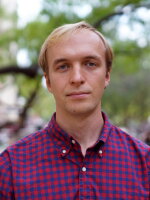
In 2022, something unusual happened in the City of South Tucson: three volunteers at a soup kitchen known for its left-wing political advocacy were elected to the city council.
They ran on an ambitious platform of fighting gentrification and housing the city’s poor. While some of it has come to pass, being inside the government has changed their perspectives and priorities.
As the end of their first terms on city council approaches, AZPM News looks back at their track record in the tiny city that Brian Flagg, a city council member and long-time local activist, calls a “one-square-mile place to experiment.”
Part I
The Casa Maria Soup Kitchen is a tiny space on a dusty city block. But it holds a remarkable amount of activity: volunteers hauling crates of fruits and vegetables, meat and eggs boiling on the stove, a constant stream of people collecting food.
For decades, South Tucson city council member Brian Flagg has lived and worked at Casa Maria. The soup kitchen is a Catholic Worker House, part of a network whose residents devote their lives to charity, voluntary poverty and political work on behalf of the poor.
“That sets us apart from Mother Theresa, and just charitable efforts, because they just put a Band-Aid on the system that’s responsible for this huge inequality of wealth,” he said.
Surrounded entirely by Tucson, the City of South Tucson occupies just one square mile. It has a majority-Hispanic population of fewer than 5,000 people, according to census data. Its median family lives on $45,000 per year, according to the American Community Survey.
The city’s mayor is Roxanna Valenzuela, who also runs Casa Maria’s affordable housing program. She said getting into government has come with one main lesson.
“It’s easier to be yelling and screaming and demanding change than to actually be in government, strategizing and executing something that is going to give lasting results,” she said.