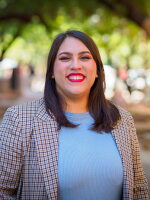
For the past 21 years, Brandy Foster’s life has centered around one person: her daughter, Alexa.
Alexa has autism and needs help with everyday tasks: getting dressed, taking a shower, preparing meals. For most of her life, Brandy and her husband have provided that care themselves. Brandy, who has muscular dystrophy, said caregiving was only further complicated by her own disability— leaving a physical and emotional toll.
That began to change six years ago, when the family met Anna Gonzalez.
“Anna just had the perfect mix of empathy and kindness but also firmness,” Brandy said. “She doesn’t let Alexa get away with things, and that’s been huge in helping her grow.”
Gonzalez is more than a caregiver. She’s become part of the family and her job is funded through Medicaid’s Home and Community Based Services program, or HCBS. It’s what allows Alexa to live at home, with the people who love her, instead of being placed in an institution.
But that care — and that connection — may not last.
A personal bond, a public threat
Under President Donald Trump’s budget — a plan he has referred to as his “one big, beautiful bill” — there is a provision that allows states to expand HCBS for individuals who do not meet the institutional level-of-care requirements. But this change is set against a backdrop of significant Medicaid cuts that could hinder or even reverse HCBS expansion efforts. It is estimated that Medicaid funding would be reduced by more than $1 trillion over 10 years.
If HCBS loses federal funding, states like Arizona could be forced to reduce or eliminate services. That could mean the end of paid caregiving for families like the Fosters.
“If she loses that program, I don’t have a job. I won’t get to see her anymore,” Gonzalez said. “Alexa’s like the closest thing I have to having a child. I’d be childless.”
That bond goes both ways. When asked if she loves Gonzalez, Alexa responded using her communication device: “I love Anna.”
“What I’m doing matters to her,” Gonzalez said. “She trusts me. She knows I have her back.”
Jon Meyers, executive director of the Arizona Developmental Disabilities Planning Council, said the impact of the proposed cuts could be devastating — especially in Arizona, which is considered a model for efficient, community-based disability services.
“But we don’t have the $2 billion it would take to replace that federal funding,” Meyers said. “We are going to see people with severe disabilities without any form of service, without support to meet the needs of daily life.”
Arizona Gov. Katie Hobbs fully funded the state’s Department of Developmental Disabilities for the current fiscal year, but Meyers said that does not guarantee protections beyond that.
“I foresee a very dark period ahead unless some changes are made to this legislation,” he said.

‘He didn’t listen’
Brandy Foster said she reached out to her congressman, Rep. Juan Ciscomani, R-Ariz., urging him to oppose the proposed budget.
“I saw him rejoicing after the bill passed,” she said. “And I thought he didn’t listen. He didn’t care what we needed.”
When asked by AZPM News how the Medicaid cuts might affect families with disabilities, Ciscomani said, “This does not impact the population that needs it the most.”
“We don't want to see people that need Medicaid knocked off this and that's one of the biggest pieces of misinformation out there. People that are on Medicaid that either have disabilities or that have caregivers have fear over losing that.”
He did not talk about the HCBS program or whether paid caregivers may be protected.
Foster and other advocates are fearful of what may come with what’s at stake if HCBS is downsized or goes away.
“Most people with disabilities would be shuffled off into an institution,” she said. “And those institutions are rife with abuse because people are vulnerable there.”
Brandi Coons, an advocate with the Raising Voices Coalition, said families are preparing to fight back.
“We’re not going to just take this lying down,” Coons said. “We’re going to share our stories. We’re going to ask for meetings.”
For the Fosters, it’s simple. Care doesn’t look like a hospital or a group home. Care looks like Anna.
“Something so simple for us was so hard for her,” Gonzalez said. “And to see her do it, that’s huge. That’s independence.”
And for now, at least, it’s still possible — with help.
Correction: A previous version of this article incorrectly identified Anna Gonzalez.
Watch this story on Arizona Illustrated.