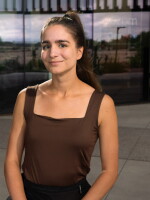
A star UA track and field athlete’s life took an unexpected turn after graduation. Skylar Sieben traded the desert heat for racing in ice and snow, and now has a chance to qualify for the 2026 Winter Olympics with the Canadian bobsled team as a brakewoman.
Sieben was already the “unicorn” on the UA track team competing in heptathlon, but her decision to switch to a winter sport made her even more exceptional. The 25-year-old athlete described the switch as a ‘spur of the moment’ decision, which she made after finishing her master’s degree in cellular and molecular medicine.
“I never would have thought I would be warming up on slabs of ice out on the concrete, in minus 10 degrees in a full snowsuit,” Sieben said. “If you would have asked me two years ago, I wouldn’t have thought that my days would consist of this. I was done with track, and it was a great five years but I was definitely ready to move on - didn’t realize this was the next chapter.”
Trying out for the bobsled team was recommended to her by UA pole vault coach, Dominic Johnson, who thought Sieben would be great at the sport. He was right - Sieben is now a brakewoman for Canada’s national team, earning a World Cup bronze medal in her rookie year.
“There’s so many people on this team that were former track and field athletes,” she said. “They kind of refer to bobsledding as a ‘sport after sports’, so no one on this team actually grew up wanting to do this. The coaches really like it when athletes have a track and field background and they can do all the running and sprinting.”
Sieben travels with her team five months a year, which she describes as an ‘underfunded Formula One’. Responsibilities include driving from country to country in Europe and maintaining heavy sleds.
“It is a traveling circus with no staff. We are the staff, we are the athletes, we drive the big sprinter vans with the sleds on top from Latvia to Norway, all the way to unloading it and sanding down the runners and getting it ready.”
Unlike in a track meet, the job is not done for her and her teammates after she finishes her event.
“That was actually probably the biggest thing I had to adjust when I switched from track to bobsled,” she said. “With track meets, you show up, you compete, but here there is also a long haul of manual labor. Lifting 180 kilogram sleds takes a toll on the body, but you definitely get used to it.”
Sieben added that while bobsledding in Canada comes with hefty expenses, she doesn’t regret her decision one bit.
“It’s tough to decide to do this, instead of starting a job where you can actually make money,” she said, adding that the goal for most people is not to leave the sport with any debt. “It’s funny thinking back that ‘oh, I could’ve accepted this job’, but when I look back on the adventures that I went on, it’s way better than any money that you could’ve made in your first year of working.
Just two years into the sport, Sieben is currently waiting to see if she qualifies for this year’s Winter Olympics as a brakewoman.
“It’s a very competitive field this year; six brakewomen are on tour and the coaches will decide who is going to the Olympics based on their performance” she said. “The name of the game is staying fast and staying healthy, because you don’t know if you made the team until the end of January.”

Apart from being an athlete, Sieben is a “biology lover”, and would love to work in the field - unless her life takes another unexpected turn.
“I love the science world and I love explaining science topics to people, that’s kind of what I’m thinking - but who knows,” she laughed.
The Canadian bobsled traveling team will be announced later this week. If Sieben qualifies, she will compete at the Olympics stage in Italy’s Cortina Sliding Center late February.
Update: Skylar Sieben qualified for the Winter Olympics.