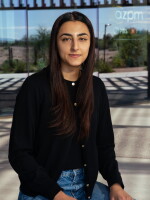
“Raise your hand if you have ever felt unseen or like an afterthought.”
That’s the question Joanna Labija posed to a room of about 50 hand-raising people while presenting her progress as a JustArts fellow.
Labija is one of just six University of Arizona students from various fields of study who recently celebrated their fellowship projects with the Arizona Arts community, family and friends. Projects ranged from Mexican embroidery crafting and sculptures made from 3D-printed waste, to surveys of campus life and animated short films.
JustArts, now in its fourth year, offers mentorship and resources for student projects that blend art with activism, a theme that was especially poignant this year after several efforts by university administration to minimize diversity, equity and inclusion standards on campus.

For Aaliyah Radebaugh, it was the closure of the UA’s Office of Diversity & Inclusion and the restructuring of cultural student centers that informed her project, titled: “Wishing for Change, Creating Tomorrow.”
“We have disabled students not being recognized. We have people of color being attacked on campus. And even when it comes to trans identities, they're being erased,” she told AZPM. “I see their cries and I see their pain and I want to recognize that, but I also want to transform it into something of hope.”
Radebaugh — who is AZPM’s student animation specialist — is creating animated short films based on student testimonials in the wake of DEI rollbacks on campus. Through these conversations, she said, the concept of a wish has become an apparent motif in how she and her peers think about campus life.
“A wish is something that I feel gives hope, because when you make a wish, you usually wish for something good. When you wish on a star, when you wish on a birthday candle, you’re wishing for something good. And I wanted to bring a light to this darkness,” she said.
To expand the project beyond animation, Radebaugh is creating a website called The Wishing Well that will allow students to share their hopes for a more equitable campus environment.
Similarly, Labija’s project, “Here to Stay,” is a response to student erasure on campus. It started with the goal of facilitating honest discussions.
“My goal for ‘Here to Stay’ is to create a space where there is room for reflection, impact and also learning of different perspectives. Even us learning from the perspective of the very people that are hurting us,” she told AZPM during an interview last October.
Labija’s vision then was to collect qualitative data from focus groups that centered on minority experiences on campus; make images of students in their cultural attire posing near prominent UA landscapes; and to culminate the entire project with a public photography exhibit. And while bits and pieces of the project have changed, her motive has remained constant.
“I think that my contribution to making a change here on campus is simply by making a space where other racial minority students can feel among other people and like they can look at these pictures or they can hear these quotes and relate,” Labija said, before presenting on her progress in February.
Now, Labija said, she hopes to instead distribute the final project through digital advertisements, or even a billboard “so that the end result doesn’t get limited to just one room.”
While presenting, Labija said she gathered several alarming accounts from students during her focus group discussions.
“One thing was clear: that belonging on campus is not automatic. It's negotiated. And it looks different for everyone,” she said.
Fate of DEI unclear on public campuses##
Last year, following the public-facing closure of the UA Office of Diversity and Inclusion, and the deletion of diversity-focused language from the UA land acknowledgement statement, the student cultural groups were centralized under one department now known as the Student Culture and Engagement Hub. Those groups were forced to avoid words like “Asian”, “Black,” “Trans” and “Queer” in their new center names.
The university also quietly restructured the Living Learning Communities, which were housing programs that grouped students from similar backgrounds together on the same dorm floor. Those spaces will no longer be available next school year and will instead be centered around interdisciplinary interests like leadership and sustainability.
“If they take away our physical spaces, we're just going to build our own,” Radebaugh said. “And the thing about a digital space is that it's not so easy to get rid of.”
Amy Kraehe is the associate vice president of organizational excellence and impact in the School of Art. Welcoming people to the February JustArts celebration, she said the donor-funded fellowship recognizes students as more than creators.
Kraehe recognized the fellows’ “membership in a distinguished community of change makers to possess the courage and the audacity to challenge the status quo and the artistry to build something better.”
Last year, President Donald Trump rolled out a series of executive orders that would cut DEI policies from universities alongside other federally-funded institutions. According to the Columbia Spectator, a federal appeals court has lifted a Feb. 6 preliminary injunction that blocked Trump’s dismantling of DEI on public campuses.