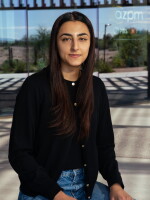
Dr. Noshene Ranjbar was born in Iran on the precipice of the Islamic Revolution of 1979.
“It was pretty horrific,” she says. “Not as horrific as it is now, but it was the beginning of everything kind of shutting down and human rights violations and people not being allowed to believe their religion or speak their truth.”
Ranjbar is an associate professor of psychiatry in the University of Arizona College of Medicine. She’s also co-founder of Empowering All Relatives to Heal, or EARTH. It’s a nonprofit that holds workshops, advocacy and therapy groups based on training from the Center for Mind-Body Medicine where Ranjbar is a faculty member.
Over the years, she’s made connections with people inside Iran through EARTH’s Iran & Afghanistan Health Sovereignty initiative. Ranjbar has trained more than 100 Iranians virtually in Farsi to facilitate trauma relief group sessions and, altogether, the Center for Mind-Body Medicine has supported 12,500 people across the Farsi-speaking diaspora.
She says the need for these sessions has grown exponentially with the current war in Iran. They’re being held in homes, shelters and even barber shops after hours.
“They just need a private, safe space so that they can gather and support each other, learn the techniques and hear each other. And allow each to express the tears, the fears, the hopes, the dreams. It’s transformative,” she says.

The therapies of mind-body medicine vary between situations, and Ranjbar says each group’s culture is integrated into the techniques. Some techniques have to do with breathing, movement, drawing, writing and bio feedback and are built on the philosophy that humans have the inherent ability to heal themselves.
“They are incredible in what they have been able to do to support resiliency building, healing, empowerment, helping people find their voices, helping people recognize how strong [they are], how it's culturally rooted, how many gifts they have within themselves,” she says.
The emotions of Iranians within the country and around the world are complex right now. Within, there’s a lot of fear, but also hope. Ranjbar says her contacts in Iran have been waiting for foreign intervention at this scale for a long time, out of desperation.
The Islamic Republic has suppressed the voices who speak out or act against its regime. Scientists, filmmakers and journalists are just some of those who are commonly detained or killed. People from minority faiths also live in constant danger.
This January, it is estimated that tens of thousands of anti-regime protesters were killed by revolutionary guard members in a matter of a few days.
“They go into the street and yell and scream and get killed because they want the outside world to see how desperate and how angry and how rageful and how united they are against the regime. But unfortunately the West has not seen that,” Ranjbar says.

By the time she was nine years old — the age of maturity for girls in Iran — Ranjbar was required to veil her head and cover most of her skin in public from head to toe.
She recalls one day when she was walking on the street in Tehran with her mother. Both of them were wearing nail polish and had a bit of their hair showing outside of their hijabs.
“The morality police pulled us over and of course I didn't know what was going on, but they forced us inside the van and the woman who was supposed to be the one talking to women basically cussed out my mom and said ‘You're a slut,’” she says.
Ranjbar left Iran when the country was 10 years deep into the Islamic regime. But today, 47 years into the regime, women are still detained and even killed for the same reasons.
The road ahead is precarious, but Ranjbar says one thing is clear.
“They don't want an outside government to come tell them what to do. They want the outside help — as they see it — to get rid of the abuser, the murderous regime that has been killing them,” she says.
Ranjbar says mind-body medicine in these times can be the antidote to feelings of hopelessness and loneliness that can crush people on the inside, even more than the outside enemy can.
EARTH is currently fundraising for its Iran & Afghanistan Health Sovereignty program, which supports mind-body trauma relief across the Farsi-speaking diaspora.