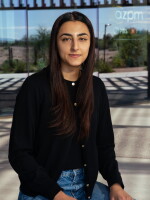
Tucsonan Cassidy Araiza has photographed a range of stories for The Wall Street Journal — from the cheer squad at a Sun City retirement community to stories covering the fentanyl crisis and border issues.
Araiza has contributed his signature flash photography to the WSJ for about a decade. His playful, vivid images have also appeared in The New York Times, The Smithsonian and Vogue, among others.
Now, he’s now one of more than 650 photographers nationwide asking the WSJ to reconsider a new contract they say strips freelance photographers of their copyright.

“It was an amazing publication to work for until this most recent year, when the new contract that was sent out to freelancers came out, which I am not signing,” Araiza said.
Under the new work-for-hire model, the WSJ can resell a contributor’s images. Previously, photographers had the ability to license their work themselves. Araiza said he relied on licensing to generate extra income on top of the publication’s day rate. For example, if a documentary wanted to use an image he produced for the WSJ down the line, he had the right to accept or decline that offer.
The contract also does not protect the images from being used on artificial intelligence platforms. That’s a concern for Araiza and other freelance photographers because the _WSJ_’s owner, News Corp, opened its news content to OpenAI in 2024 for AI training.
News Corp also struck a multi-million dollar AI training deal with Mark Zuckerberg’s Meta earlier this year.
Araiza said the work-for-hire model is not typical or fair for news publications to offer. The New York Times, for instance, operates on a joint copyright agreement with freelancers which deems the photographer as the creator and owner of the media.
Araiza said so far this year, he’s lost about half the amount he made with the WSJ in 2025 due to turning assignments down.
“That is a substantial financial hit,” he said. “But I think if me and other freelancers don't take some sort of stand, it's just going to be a domino effect with other publications thinking it's okay.”
An alliance of more than 650 photographers, referring to themselves as Your Visual Colleagues, are refusing to sign with the WSJ. Araiza called it “the closest thing [he’s] ever seen to a union.”
In a recent article published by the Columbia Journalism Review, freelance contributor Daniella Zalcman wrote that she fears for her career for the first time in 20 years.
“The furious organizing coming from Your Visual Colleagues and the NPPA (National Press Photographers Association) isn’t just about the _Journal_—it’s about awareness that, like other journalists who have organized around similar concerns surrounding intellectual property and AI, the moment demands that freelance photographers either take a stand or be complicit in the demise of our livelihood,” she writes.
The WSJ did not respond to AZPM’s requests for comment. A spokesperson from the paper told Zalcman that a joint copyright would be assigned to the images despite the publication owning them. Photographers say the terms remain unclear and the spokesperson’s reply is not enough assurance.
The contract was sent out last November. When Phoenix-based photographer Jesse Rieser read it, he said he saw another asteroid coming for the news industry.
“You have this sort of perfect storm of a contracting institutional media landscape with stagnation of rates, with the introduction 15 years ago of social media and decentralization of new sources and people's attention,” he said
“The concept of freelance was hard enough and now you're fighting all these other factors, and now we're injecting the fears of AI,” he added.
Rieser has also contributed to the WSJ for about 10 years, with a focus on uniquely American themes like the national obsession with Christmas. Rieser has extensive experience in commercial advertising and news media and has seen both industries shift through the decades. But he said the WSJ contract poses new challenges.
“The death of print has been long and slow. I think that we're entering this time of accelerated change that most… things are going to be moving very fast. It's hard to kind of wrap your head around even the last two or three years of AI. And what’s next year going to look like?” he said. “I think there's just a lot of shared general uneasiness about this whole thing and people don't like it.”
Rieser criticizes the move as a way for news corporations to gain more wealth.
“I fight for that copyright. I want it for resale value. I want it for book publishing. I just want control over the things I made. The other thing, too, is this sentiment that all of these big machines [are] at play — it just feels like everybody wants to have a hand in your pocket,” he says.
Araiza, also in that fight, said he can’t imagine doing anything else. He plans to continue the freelancer’s hustle despite these obstacles.
“When you spend so much time in this industry building yourself up and being known even just for your name, and then there's a possibility it could be in jeopardy, it’s really scary,” Araiza said.