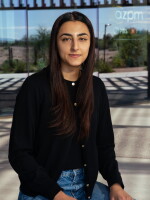
Ellie Smolen used to never come home from school excited about the day she just had.
“Ellie never was one of those kids to come home and say, ‘Hey, I learned about this and this and this today,’” says her mother, Temple Smolen.
The 15-year-old has a type of neurodivergence known as Pathological Demand Avoidance that causes severe anxiety responses to overwhelming situations. Temple Smolen says the private school Ellie previously attended was fueling those responses.
“She hit a point where the teachers just kept pushing her harder and harder and they weren't connecting with her. She lost trust in them and she just shut down,” she says.

That’s when they decided to enroll Ellie in the Desert Dragon Learning Community – a school with fewer than five staff and 15 middle schoolers learning under one roof.
Desert Dragon is one of thousands of private microschools across the country — and roughly 10 in the Tucson area — providing an alternate path to education that allows students to learn at their own pace.
Both Ellie and Temple Smolen agree that things for Ellie are much better today. She’s now in her sophomore year at Canyon del Oro, enjoying synchronized swimming and science classes. She and her mother credit her microschool experience with preparing her for public high school.
“After Desert Dragon, she came home excited, enthused, eager to share what she had learned,” Temple Smolen says.
What do Tucson microschools look like?
An estimated 750,000 to two million students attend microschools across the country, according to Rand, a nonpartisan research organization.
A large number of the microschools in Tucson are led by former public school teachers who say they’ve finished microschool prep programs with Kaipod and Arizona State University Prep Global.
Tucson educator Annie Holub founded Desert Dragon after watching her own son struggle in the public school system.
Her school is geared toward students with ADHD and autism.
“These are the kids that get kicked out of schools, expelled from schools for their behavior or just flat out can’t go. Like, it’s just too overwhelming. They just shut down,” she says. “We understand that, we provide resources and support for those kids so that they can still come to school.”
Students at Desert Dragon mostly forge their own paths — painting if they want to paint, learning about cults if that’s what interests them or playing with a squishy toy in the quiet room when they need to take a break. Their core classes may be online and more self-paced, or taught one-on-one by Holub. Testing is optional and never done in the typical fashion.
“We don't force, we don't push. We offer, we invite, but we never cajole,” Holub says.

At Desert Dragon, the learning space is adorned with couches, Legos and the school mascot, a live bearded dragon named Scooby Doo. Holub says the environment has “a therapeutic effect” that often helps struggling students regain confidence to enter public school.
Ellie says the two years she spent at the microschool helped her transition to a public high school where she now walks the halls alongside 1,800 other students. She says she had hours of daily instruction with Holub one-on-one, and that Holub even weaved math — something Ellie wasn’t fond of — into a fun activity like cooking.
“I didn't realize I was doing math until she goes, ‘You know you just did math?’ I was like ‘That's not nice!” Ellie says.
April Simmons is in the second year of running her own microschool, A Mind of Magic and Reason Learning Center. She joined the exodus from public into private education after teaching in Tucson’s public schools for a decade. Simmons says the outdated pedagogies in the public education system sparked her ambition to find an alternative for students.
“We're still running on a model that's 150 years old that doesn't work anymore,” she says. “We're not creating kids to go work in a factory. We're creating kids to be engineers and problem solvers for big problems, and the system that we have right now just doesn't do that.”
Her model is similar to Holub’s at Desert Dragon.
“I can have a third grader who's working on fourth grade math. I can have a sixth grader who's working on third grade math,” she says.

Simmons says she thin-slices math tasks, lets kids choose the topic for their final projects and experiments with enrichment activities. One week, it may be learning how to code, another week it could be an American Sign Language lesson or 3D printing.
Kim Kahle says that’s done wonders for her children. She says in public school, her 11-year-old daughter required a slower pace. She has autism, dyslexia, ADHD and anxiety. Kahle’s 8-year-old son also has ADHD, but wasn’t being challenged enough. Sitting at a desk for most of the day left him restless.
“We were tired of fighting to make our kids work in a system that didn't work for them,” she says.
Now, Kahle says, the two are thriving both academically and socially.
“Our daughter — she's made more growth in one year at this school than she ever made in any of the years in public school,” she says. “Her confidence is just booming.”
And her son, who’s now a fourth grader, can “continue to be challenged rather than (ask), ‘Why do I have to do this if I already understand it?’”
While they all have their niches, the common thread among microschools is that many of them are fully funded by Arizona’s billion dollar universal voucher program, or Empowerment Scholarship Accounts (ESA). It funds more than 105,000 students in microschools, traditional private schools and home schooling no matter their family’s economic status. Only about 20% of ESA recipients are students with disabilities according to the Education Department’s latest quarterly report.
The National Microschooling Center states that tuition at a typical microschool is less than $10,000 a year, but some that are tailored to students with disabilities are more costly.
A report by the National Education Association ranks Arizona’s public education system last in per-student spending, which rounds out at $12,000 on average.
In Arizona, ESA typically awards families with a yearly voucher between $7,000 and $8,000, but students with disabilities can get upwards of $45,000.
“None of my kids that I have would be here without ESA. Not a single one of them would be able to afford it without that,” Simmons, at A Mind of Magic and Reason, says.
As of Sept. 14, 105,580 students were enrolled in the ESA system, costing Arizona nearly $1.1 billion last fiscal quarter.

Reform campaign remains steadfast
While many public schools in Arizona continue to scramble for resources with limited state funding, the microschool landscape remains heavily reliant on the state voucher system which only continues to grow.
Arizona’s $8 billion pool for K-12 education is shared between public and ESA schools. That complicates matters.
“Everybody in the education space — we’re like pigeons fighting over crumbs,” Holub, at Desert Dragon, says.
Public school advocates were on track to propose ESA reforms to voters this November, before the state Supreme Court scrapped their campaign in August due to invalidated duplicate signatures.
For about a decade, reform advocates faced opposition from Republican politicians who drafted counter bills, challenged them legally or killed their proposals in other ways. In the last several years, the ballooning ESA program has forced the state to cut funding for water infrastructure, prison improvements and community colleges.
“If we can’t afford to educate all of the students in the state, that’s a bigger problem. That’s a state-level problem. That’s a governor-level program. That’s a state legislature-level problem,” Holub says. “That’s not something we should be infighting for within the education system.”
But the possibility of reform makes teachers like Holub and Simmons nervous. The ones proposed for this year’s ballot would have returned leftover ESA funds to the state at the end of each school year and every two years from the accounts of students with disabilities.
Some students use those leftover funds to save for more expensive equipment, for college or for vocational program tuition.
“We're not afraid of accountability. We're not afraid of somebody paying attention to where we're spending our money. We're not afraid of any of those things. The only part that really scares us is taking things from kids,” Simmons says.
Reform advocates were also pushing to require standardized tests in ESA-funded schools, with exceptions for those tailored toward students with disabilities. Nevertheless, Holub says there are students who may go undiagnosed, or who learn in different ways that may still need to sit out on test taking.
“Testing is a huge, huge barrier for a lot of neurodivergent kids. The tests are not designed for neurodivergent brains. They are highly stressful,” she says.
Those reforms are off the table for now, and the teachers say they’re relieved. But the potential for a change in the program still looms. If House Democrats take the majority in the midterms, legislative reforms on the ESA program would have a better chance at moving forward.
Terry Leyba Ruiz is the Democratic nominee in Arizona’s race for superintendent. She says she would advocate against the universal ESA program if elected.
“There's a consensus that the vouchers need to stay for our children with special needs and special education. That's not the issue,” she says. “What has people very upset is the universal vouchers and the idea that public dollars would be used for private decisions.”
Gov. Katie Hobbs has also hinted at reforming the program, though that hasn’t been a central piece of her reelection campaign.
An imperfect solution
Currently, the state has little power over non-public schools. It doesn’t require staff in those schools to be regularly fingerprinted or teachers to be certified — although Holub and Simmons are.
The state also can’t enforce standardized testing, mandate specific curricula or assign letter grades to private schools. That’s why in microschools, teachers can personalize their lessons — accelerate them, or go slower.
On the other hand, it’s not clear that all the private microschools in the state are providing a high quality education. According to the ESA Parent Handbook, account holders are required to purchase materials related to the core subjects of math, science, social studies and language arts. The exact process for those audits, however, is unclear.
Doug Nick, a spokesperson for the state Education Department, tells AZPM that every purchase request above $2,000 is reviewed prior to approval. Those that are below $2,000 are automatically processed and “then subject to risk-based auditing.”
“I do know people who have had their account suspended because they didn't spend in all those four categories, so they are checking it. I just don't know, like — are they checking everybody?” Holub says.
Temple Smolen, Ellie’s mother, says she sees that as a limitation of ESA too.
“There isn't really a statewide standard for microschools and accountability around academics for them. That really becomes incumbent on the parents to work with the teachers,” she says.
While it’s not a perfect solution, Simmons says having the microschool structure available to Tucson’s students will help fill the gaps of traditional systems until those systems themselves are fixed.
“I hope that one day there is no need for what I'm doing and I'm able to return to the public school system and bring what I've learned here there,” Simmons says.