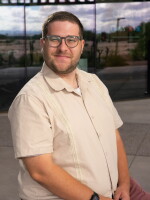
Adam Harper had relatively little experience with the ocean before stepping aboard the EV Nautilus – to be expected for someone who grew up in Tucson.
He had helped his father at a local seafood market, played ocean-specific video games and focused on oceanography for his degree in film and television at the University of Arizona. But prior to a month ago, he had never spent an extended period at sea.
That changed Aug. 20, when Harper began a 29-day expedition across the Pacific Ocean. He worked in the ship’s camera operating room alongside two other assistants, taking four-hour shifts every eight hours.
“Across the month that we were out there at sea, there wasn't a consistent amount of time where we were underwater,” Harper says. “Most of the time we were either in one of three modes: We were in transit, we were in dive or we were in mapping.”
The 24-year-old operated the expedition’s camera systems, managing everything from color and audio levels to some post-production before footage was broadcast to thousands of viewers via the Nautilus Livestream.
The expedition focused on specific areas of the Pacific where scientists hoped to make new discoveries. Some sites had never been researched, while others had not been surveyed for decades.

One target was the seafloor near the U.S.-owned Wake Atoll, where the crew searched for remnants of the Battle of Wake from World War II. The team surveyed 5 square kilometers of seafloor looking for an Imperial Japanese Navy Destroyer named Hayate that had been carrying some of the kamikaze-style planes involved in a wave of bombings leading up to the attack on Pearl Harbor.
They did not find the aircraft—nor any other remnants from the 1940s. They found out that what had been previously identified as aircraft wrecks were actually geological formations.
The crew did discover a U.S. Air Force barge that scientists determined was built after World War II and purposely sunk.
“When we first made the discovery, one of our scientists from the shore was actually helping us out. They mentioned that this particular type of barge had been discontinued around the ’70s,” Harper said. “They could tell pretty quickly looking at it that it was an intentional scuttle.”
The barge is still being identified because it does not appear in wartime records maintained by the U.S. government.
For Harper, the unexpected discovery became another avenue of exploration.
“Once we joined the archaeological hunt it was as if we started a new endeavor — a new expedition,” he said. “It was very cool to spearhead that pursuit between both U.S. and Japanese forces to find and memorialize these grave sites to honor their troops and those who died trying to fight for their countries.”
The expedition also brought opportunities to document rarely-seen marine life.
Scientific confirmation of a species can take years. Harper said a goblin shark filmed during an expedition in 2019 was not officially confirmed until 2026.
“So, when I say it's on the timeline of years, unfortunately, I mean it,” Harper said.

Other discoveries happen much faster. On Harper’s mission, lead scientist Steve Auscavitch, whose research focuses on deep-sea octocorals in the Pacific, encountered an octocoral that he could not immediately identify.
The species still needs to be formally confirmed, but Harper recalls the crew gathering around the ship's monitor when they realized they may have encountered something new.
Some dives in the Hercules ROV submersible reached depths of nearly 19,000 feet, allowing scientists to film deep-sea life and, when equipped with a new eDNA sampler, collect samples for research. Other submersibles that could go deeper and capture footage lacked the equipment to bring specimens back to the surface.

The expedition also took the crew across geological formations on several abyssal plains.
Harper said he was less concerned about what was below the ship than what was happening aboard it at night.
“Most of my concerns came about from nights that I spent on the vessel itself asleep. In those moments I would typically hear the ship making a lot of noise and I would be worried,” he said.
Crew members reassured him that the sounds were simply coming from the ship’s various operating systems.
By the end of the expedition, the scale of the mission was reflected in the numbers.
Megan Cook, director of education and outreach with the Ocean Exploration Trust, said the team deployed remotely operated vehicles for 283 hours, or nearly 12 days, across 13 dives. The expedition also mapped 65,350 square kilometers of seafloor in the Western and Central Pacific, one of the largest sea mappings in any one OET expedition, according to Harper.
For Harper, however, the significance of the expedition goes beyond the miles mapped or hours spent underwater. It’s in the possibility of finding something no one has seen before.
“If you've ever sat down and thought to yourself, ‘What if there is something out there that we don't understand? What if there are parts of the world that haven't been discovered?’ – the deep sea is one of the last truly unknown frontiers on Earth,” Harper says. “And if you have that spark to know more – to discover – this is something that you should easily consider.”